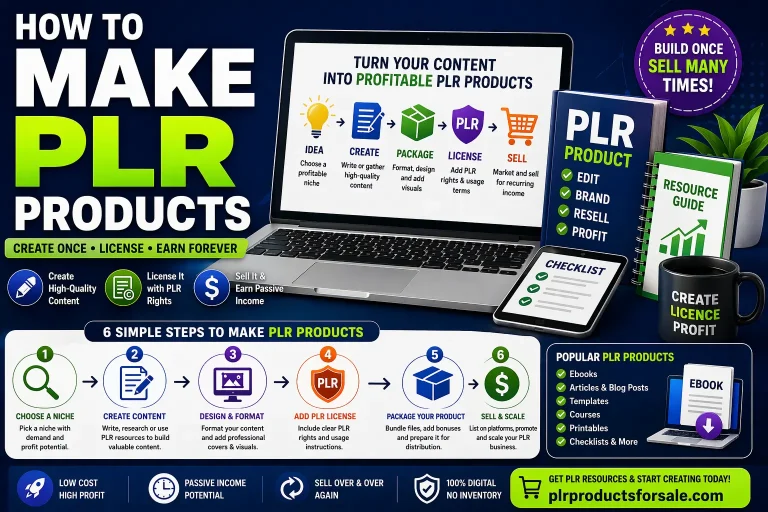
Selling PLR products online can become a practical digital business when you treat private label rights as raw material rather than instant income. PLR, or private label rights, generally allow a buyer to edit, rebrand, and resell content under agreed license terms. Depending on the license, products may include ebooks, courses, templates, checklists, graphics, software, audio, or video. Your opportunity is to turn a generic asset into a focused solution for a specific audience, then present and deliver it professionally.
Maximum profit rarely comes from uploading an unchanged file and hoping buyers discover it. Strong results usually come from choosing useful material, improving it substantially, selecting a profitable niche, creating a clear offer, and building a repeatable marketing system. This guide explains how to make those decisions, avoid common mistakes, and create a PLR store that customers can trust.
Sell Plr Products Online: Understand What You Are Selling
A PLR product is not automatically an original creation, and purchasing it does not necessarily grant unlimited rights. Read the license before editing, branding, bundling, or reselling anything. Some licenses permit commercial resale but prohibit passing on PLR rights. Others restrict selling through marketplaces, using particular claims, giving away source files, or presenting the material as legal, medical, or financial advice.
Keep the license, supplier details, purchase receipt, and permitted-use notes in one organized folder. Record which changes you make and where every asset came from. This simple documentation protects your business and helps you answer customer questions accurately.
Customers do not really buy a file. They buy a result, such as a clearer budget, a faster content plan, a better onboarding process, or a more organized home office. Therefore, evaluate each PLR package by asking three questions: Who needs this? What problem does it solve? Why would that person choose my version instead of a free alternative?
A broad product may serve as useful research, but a narrow product is usually easier to market. “Healthy recipes” is vague. “A four week meal planning workbook for busy vegetarian families” gives you a defined reader, promise, format, and promotional direction. Specificity also makes customization more meaningful.
Choose a Profitable Niche
A promising niche combines a recognizable problem, reachable buyers, existing interest, and a reasonable ability to pay. It should also match your knowledge or willingness to research. Popular categories include personal productivity, business operations, education, hobbies, home organization, fitness habits, and creative skills. Popularity alone is not proof of profitability; crowded categories require stronger positioning and better execution.
Begin with audience research. Read questions in relevant communities, examine reviews of competing products, and note recurring complaints. Pay attention to the language people use to describe their frustrations. Those phrases can guide your title, sales page, examples, and email messages. Do not copy competitors. Use observations to identify an underserved angle.
Define a buyer profile that is useful without pretending to know unsupported personal details. Describe the buyer’s role, experience level, objective, obstacles, preferred format, and likely purchase concerns. A beginner may value explanations and examples, while an experienced professional may prefer a concise template and implementation checklist.

Test demand before investing heavily. Create a simple waitlist, publish educational posts, offer a small sample, or ask potential buyers to choose between several concepts. Responses are not guaranteed sales, but they can reveal whether your proposed problem feels urgent enough to solve.
Select and Improve the PLR
Before buying, inspect the sample pages, table of contents, file formats, update policy, and license. Check whether the writing is coherent, whether examples are current, and whether images or fonts have separate restrictions. Avoid packages that make suspicious claims, contain unattributed quotations, or appear assembled from incompatible sources.
Treat the first draft as a foundation. Start with a structural review. Remove repetition, weak introductions, outdated references, irrelevant sections, and promises the material cannot support. Then improve the substance with original explanations, examples, worksheets, decision trees, checklists, and implementation steps.
Your edits should reflect a coherent point of view. Rearranging paragraphs is rarely enough to create meaningful differentiation. Add a framework that helps readers decide what to do first, what to avoid, and how to measure progress. If the original product lists ideas, transform those ideas into a guided process. If it explains concepts, add exercises that help users apply them.
Verify every factual claim that could affect a buyer’s decisions. This matters especially for health, law, finance, cybersecurity, employment, and regulated industries. Remove unsupported guarantees and include appropriate limitations. When information may change, use cautious wording and review it before republishing.
Use professional design, but do not confuse decoration with usefulness. Consistent headings, readable spacing, accessible contrast, page numbers, editable fields, and clear instructions can make a modest product feel substantially more valuable. Export a stable version for ordinary customers and, when permitted, provide editable files separately.
Build an Offer Instead of Listing a File
A profitable offer explains the transformation, contents, format, support, and boundaries. Give the product a benefit-led name that is specific without promising unrealistic outcomes. A title should help the right buyer recognize relevance quickly.
Explain what the buyer receives. List the modules, worksheets, file types, access method, update policy, and any bonuses. If a bonus is included, ensure it supports the main outcome rather than padding the product. A short implementation calendar, prompt library, or progress tracker can increase practical value when it genuinely saves time.

Pricing should reflect audience value, product depth, differentiation, support, and selling costs. Do not choose a price only because another seller uses it. A low price can attract impulse buyers but may also signal limited quality or create support-heavy volume. A higher price requires clearer positioning, stronger presentation, and confidence in the customer’s expected benefit.
Consider a product ladder. A free checklist can introduce your method. A focused starter product can solve one narrow problem. A larger bundle can serve buyers who want a complete system. A premium option might add customization, group support, or implementation guidance, provided you can deliver those elements reliably. The ladder gives customers appropriate choices without forcing everyone into one offer.
Write a sales page that answers practical objections. State the problem, describe the proposed outcome, show what is included, explain who the product suits, address limitations, and provide a visible purchase path. Use previews such as sample pages or screenshots only when they represent the actual product. Avoid fake scarcity, fabricated testimonials, and claims of guaranteed results.
Choose Your Selling Channels
Your own website gives you control over branding, customer data, pricing, and follow-up communication, but it requires setup and traffic generation. A marketplace may provide built-in discovery and payment handling, while imposing fees, content standards, and account rules. Social platforms can support attention and conversation, yet they are less reliable as the sole home for your business.
Choose channels according to the product and audience. A visual template may benefit from image-led discovery. A business workbook may perform better through professional networking, partnerships, webinars, or an email list. A specialized course may require demonstrations that show the teaching approach.
Before launching, test the complete customer journey. Click every link, complete a test purchase, download files on multiple devices, inspect confirmation emails, and confirm that refund instructions are easy to find. Check whether file names are clear and whether customers know where to begin. A polished delivery experience reduces avoidable support requests.
Collect consent appropriately for email marketing, explain what subscribers will receive, and provide a straightforward unsubscribe option. Keep customer records secure, minimize unnecessary data collection, and review the privacy and consumer rules relevant to your location and audience. When uncertain, obtain qualified legal guidance rather than copying generic policies blindly.
Market With Useful Content
Content marketing works best when each piece helps the same audience make progress. Publish tutorials, comparisons, demonstrations, checklists, short case examples, or answers to common questions. Connect the free content naturally to your paid product. If a post teaches how to plan a project, your paid workbook might provide the complete planning system.

Build a simple conversion path. A visitor may discover an educational article, download a relevant free resource, receive a brief email series, and then see an offer. Each stage should deliver value and set accurate expectations. Do not send subscribers unrelated promotions merely because another product is available.
Use product demonstrations to reduce uncertainty. Show a page being completed, a template being customized, or a lesson being applied. Explain what the buyer must do and what the product does not do. Transparency attracts better-fit customers and can reduce refund requests.
Partnerships can extend reach without requiring a large audience of your own. Consider affiliates, complementary creators, professional associations, newsletter owners, or educators. Offer clear promotional materials and define commission terms in writing. Never ask partners to make claims you cannot substantiate.
Paid advertising can accelerate testing, but it also magnifies weak positioning. Begin with a modest, controlled experiment only after your landing page, checkout, tracking, and fulfillment work. Compare audiences, messages, and offers one variable at a time where practical. Stop campaigns that spend without producing meaningful evidence, and account for refunds, fees, taxes, and support when calculating profitability.
Measure the Numbers That Matter
Track visits, opt-ins, product views, purchases, conversion rate, average order value, refund rate, advertising cost, and support volume. These metrics answer different questions. Traffic indicates reach; conversion indicates offer clarity; average order value reflects packaging; refunds may reveal mismatched expectations; support volume can expose confusing instructions.
Calculate profit rather than celebrating revenue. Subtract platform fees, payment processing, advertising, contractor costs, software, taxes, refunds, and your reasonable time estimate. A product that sells frequently but requires extensive manual support may be less attractive than a slower product with clean delivery.
Review performance by traffic source and product version. If visitors engage with educational content but do not buy, the offer may need a clearer outcome or stronger proof of usefulness. If sales occur but refunds are high, inspect the promise, preview, onboarding, and product quality before increasing promotion.
Provide Excellent Customer Experience
A customer should know what happens immediately after payment. Send a clear confirmation, download instructions, access details, license reminders, and a recommended first step. Include a troubleshooting page for common issues such as missing emails, incompatible files, or forgotten passwords.

Support does not need to be elaborate, but it should be dependable. Set realistic response expectations and create saved answers for recurring questions. Invite customers to report errors and confusing sections. Their feedback can guide revisions and reveal opportunities for complementary products.
Updates can strengthen long-term trust. Correct errors, replace obsolete examples, improve instructions, and communicate meaningful changes. Do not promise lifetime updates unless you understand the continuing workload. A defined update period may be more sustainable and easier to explain.
Refund policies should be clear and consistent with applicable requirements and platform rules. Treat a refund as information, not automatically as evidence of abuse. Patterns may indicate that your sales page overstates the product or that buyers need better orientation.
Common Mistakes to Avoid
The most common mistake is reselling unchanged PLR with a new cover. Buyers can encounter identical material elsewhere, damaging your reputation and making price comparison easy. Another mistake is purchasing large bundles before validating a single audience problem. More files do not automatically create more value.
Avoid building a store around unrelated niches. A coherent catalog helps customers understand your expertise and makes cross-selling more natural. Avoid relying on one traffic source, too; algorithmic distribution, marketplace policies, or advertising costs can change.
Do not ignore accessibility. Use meaningful headings, readable typography, descriptive image text where relevant, and documents that work with common tools. Do not hide important license restrictions in vague language. Clear terms protect both parties.
Finally, avoid promising results you cannot control. A workbook can provide structure, but it cannot guarantee a particular income, weight change, grade, diagnosis, or legal outcome. Responsible positioning is persuasive because it establishes credibility rather than exploiting anxiety.
Frequently Asked Questions
Can I sell PLR products under my own brand?
Usually, a suitable PLR license permits rebranding, but permission varies. Read the exact agreement before changing ownership statements, removing credits, bundling files, or granting customers additional rights. Keep evidence of the license and do not claim that you personally created every underlying element if the terms or ethics of your market require disclosure.
Should I rewrite every word?
Not necessarily, but meaningful improvement is usually wise. The appropriate level depends on quality, audience needs, product type, and differentiation goals. At minimum, review accuracy, structure, examples, design, instructions, and legal or safety-sensitive claims. A superficial cover change leaves little reason for buyers to choose your edition.
Where should I sell?
Use a channel your audience already trusts and where the product format performs well. Your website offers control, marketplaces may offer discovery, and partnerships can provide qualified referrals. Many sellers combine channels, but begin with a manageable setup and confirm each platform’s license, content, payment, and refund requirements.
How can I compete with free content?
Compete through focus, organization, usability, and implementation. Free information may be scattered or generic. A well-designed product can save time by combining relevant explanations, examples, templates, and a sequence of actions. Show that convenience and guidance clearly, without dismissing free resources or making inflated claims.
How many products should I launch?
Launch enough to test a clear concept, not enough to create confusion. One strong product can reveal whether your audience, offer, channel, and delivery work. Use buyer questions and sales data to decide what to add next. A small, coherent catalog is often easier to improve than a large, neglected one.
Can I use PLR for sensitive topics?
You can only do so responsibly when the license permits it and the content is accurate, current, and appropriately qualified. Health, legal, financial, and safety topics demand special caution. Avoid diagnosis, guarantees, individualized professional advice, and unsupported claims. Consider review by a qualified professional before publication.
A Practical Launch Plan
Start by selecting one audience and one urgent, clearly defined problem. Research the language, alternatives, objections, and desired format. Choose a PLR package only after examining its quality and license. Create a brief improvement plan that identifies what you will remove, rewrite, add, design, and verify.
Next, produce the smallest complete version that genuinely solves the stated problem. Build the sales page, checkout, delivery email, support instructions, and license information. Ask a few suitable reviewers to identify confusing claims or missing steps. Their role is to test clarity, not to provide fabricated endorsements.
Launch to a focused audience using helpful content, direct outreach where appropriate, or a small partner campaign. Observe questions, clicks, conversions, refunds, and completion difficulties. Revise the product and message based on patterns, not isolated reactions. Once the process is reliable, add a complementary offer or improve distribution.
Conclusion
Selling PLR products online is most profitable when you operate as an editor, educator, marketer, and responsible business owner rather than as a file reseller. Choose a specific audience, confirm the license, improve the substance, package a useful outcome, and make purchasing effortless. Market through genuinely helpful content, measure actual profit, protect customer trust, and use feedback to guide every revision.
PLR can shorten production time, but it does not remove the need for judgment. Your differentiation comes from relevance, accuracy, organization, design, support, and honest positioning. Begin with one well-defined problem and a product that helps solve it. A focused, trustworthy offer has a stronger foundation for sustainable growth than a crowded store filled with lightly edited files.